Showing posts with label trail running. Show all posts

Tuesday, November 17, 2020

How to die while running the Georgia Death Race

2020 Georgia Death Race COVID Edition
November 7, 2020 at Vogel State Park in Blairsville
, GA
Hardest race I've ever attempted, made even harder due to course changes because of COVID. Only 55% finish rate, I was one of the 45% caught by the reaper.
Watch time: 14:06:00
Position: Run, hike, crawl, DIE! I made it 42+ miles before being completely exhausted and mentally drained.

 
GoPro Race Video - ???
 
    I struggled for a week whether I wanted to write another DNF race report. It was hard enough after my Barkley Fall Classic fail last fall. But this one feels different. This one is a result I can live with, and I'm viewing it through a much different lens than I would have a year ago. See, I have this penchant for attempting races that tend to be well beyond my ability as a runner. I find joy in the suffering and pushing myself beyond what I think I'm capable. Sometimes I find that my ability is much more than I thought it was, and that is how I'm feeling after this effort.

    Georgia Death Race - the name itself is enough to strike fear into any runner. Once you dig into the stats it's even more frightening - 74ish mile point to point race with over 14,000 feet elevation gain and 11,000 feet of loss, with a 24 hour time limit. If only we were so lucky - thanks (no thanks) to COVID, there would be no point to point race due to the inability to shuttle runners from the finish to the start. This meant the route needed to be an out and back. Normally the race starts at Vogel State Park - we would begin a few miles from the park, run to Vogel and run the first 30 miles of the regular course, then turn around and run back. The first half is also the hardest part of the normal route, and the end result was a course that was 9 miles shorter but had 6,000 feet more elevation gain and 9,000 feet more loss (this is not a good thing despite how it may sound). Total stats - 65 miles, 20,000 feet of gain and loss.

    As with Quest for the Crest, this race was also going to happen in the spring. A March race would have been an absolute disaster after my break from running in January. So it was a blessing just to be able to do the race in the first place. The race start time was pushed back until 7:00am instead of the normal 5:00 (with a shuttle ride a few hours before that). My original plan was to just drive an hour and a half from our campsite the morning of the race, but I figured it would be smart to drive over the evening before so I could get as much sleep as possible before a potential all nighter. I was going to just sleep in a parking lot in the back of the car, but another runner offered a spot on the couch of a cabin he and some friends were renting. It's always fun to meet other trail runners so I took him up on that offer. After packet pickup, I grabbed some fast food on the way to the cabin. I walked in to find out that they were in the middle of grilling steaks and brats and had some for me. Awesome! We had a few beers, chatted about other races we've done, and got to bed before midnight.
 
    Up at 5:45 to eat some breakfast, load up the pack with mandatory gear - including the old railroad spike that is our burden for the race, get dressed and double check that we have everything. When you finish, you throw your old spike into a coffin and get an engraved spike for your finisher's award. Clint would start in the second wave at 7:10 and I didn't start until wave three at 7:20. I watched the other two waves take off up a very steep hill and wondered just how difficult this course would be. I didn't do my usual research of the course due to the late change and being so busy with the RV life. I like to figure out how hard each section of the course is going to be, and make a plan for how long each section should take for me to be able to finish. I was just going to wing it, and that is definitely a contributing factor to what happened later in the race. A few minutes before 7:20 (we were spread out enough since our group was fairly small) and we were off.

Early on at Vogel State Park
    After the initial climb up on asphalt, that was so steep I wondered how they paved it, we got onto what Run Bum referred to as "country club trails".  It was a very wide, slight downhill, grassy trail.  This was so easy but I was still holding back, knowing that there was so much left to do. After a few miles we ended up in Vogel State Park, where the race usually begins. There were some campers out making breakfast, some packing up camp, likely wondering what this big group of runners were doing running through the campground. It wasn't long before we turned onto the trail and had our first big climb of the day. This park is definitely somewhere I could spend a long weekend camping and running these trails, especially if (when) I attempt this race again. Unlike in Quest where I didn't eat or drink anything for the first few hours of the race, I was going to make sure I was eating and drinking plenty right from the beginning. After a mile or so of climbing, we had a very gentle two miles downhill. I thought about the fact that I would be doing all of this in reverse in the dark 20+ hours from now, and imagined what a death march that would be. But for now I was really enjoying the trail and the fact that the downhills were very run-able compared to the boulder fields of Quest. 
 
    Of course, I'm sure it's the case with any varsity level trail race like this, but as soon as you feel comfortable, just wait a minute and things will change. I was well aware of what was to come, but actually thought it was earlier in the race. At around mile 5.5 there is a climb that lasts for almost 4 miles and gains 2,200 feet. I hiked the entire thing and managed to stay around 20 minute miles. Mile 9 was in danger of taking 25 minutes, but I made sure that didn't happen by running uphill some. I thought to myself that nobody would ever build a race plan and expect any mile to take 25 minutes. But things don't always go to plan, and so you adjust and do what feels right at the time.
 
    Speaking of race plan, let's talk about that. As I said, I didn't do a lot of research on the course. Ideally, I would have known how much distance was between each aid station, where the major climbs/descents are, how much total elevation change for each segment, and time cutoffs. All I really knew was that there was a huge climb early that we would also hit towards the end, and then it was a lot of rolling hills. I wish I had some notes written out and possibly had a crew or Katie able to text me reminders of what I had upcoming. I set up my Garmin with the GPX file of the course that was "mostly accurate" according to Run Bum, and I had it build a pace plan for a 23 hour finish. That way if I could stick to that even if things fell apart later I would have an hour buffer. As for execution, I didn't really follow the paces it recommended. That is because to finish a 65 mile race, you only have to average 21 minutes per mile. Even on the downhill sections, I think the fastest pace it recommended for me was around 19:00/mile. I more used the pace targets as indicators of when the course would be a downhill run (19-21 pace), flat run (21-22 pace), uphill hiking (22-24), or soul-crushing staircase death crawls (24+). What I was really wanted to do was maintain a 3 mile per hour average pace, and build as much of a cushion on that as possible without pushing too hard. That was easy to get ahead even if I was running very slowly... for now...
 
    So that 25 minute mile 9 - I didn't feel too bad about that because I had covered the first 8 miles in exactly 2 hours. I had already built a 2 mile cushion and had the hardest climb out of the way. I was feeling great about how the start of the race was going, until I got to the first aid station around mile 10.5. At that point, my watch predicted (based on my average pace) that I would finish in 19 hours, however I was only 40 minutes ahead of the CUTOFF at AS1. I couldn't figure out that math, but I quickly realized that there wasn't any time to be messing around.  I knew a few people had probably made the mistake of thinking they could take things easy, trying to preserve themselves for later in the race, and didn't even make it past the first aid station. It makes sense to require a faster pace for the first half of the race, because as you start to tire, and especially once it gets dark, you will undoubtedly slow to a snail's pace.

    I knew that I just had to keep doing what I had been doing. Run the downhills as best I could, cautiously as the trails were all covered with leaves and there are some rocks here and there. Hike the uphills quickly and try to limit to damage as much as possible a.k.a. don't have any more 25 minute miles. The trail to aid station 2 was much shorter - only about 5 miles with a few up/downhills that were half a mile to a mile at a time. The last downhill was very steep (about 15% average grade) and I didn't run much of that. I covered the distance in about 90 minutes - an 18:00/mile pace - and lost 10 minutes on the cutoff! Chasing cutoffs would be an unexpected point of stress all day, something I hadn't anticipated to be worrying about until MUCH later in the race. We were allowed to put together drop bags for this point and one other in the race, and even though I had been eating at the aid stations,  I knew I should re-fill my pack from my drop bag, because AS 3 was only 2.5 miles away, but it would then be 8.5 miles to AS 4 and I would need plenty of my own food to eat on the long section.

    As I headed out, I checked my messages and updated some friends on my status. I saw the few other people I knew doing the race were doing well, a few miles ahead of me. I told my group that I was only a little bit ahead of cutoff and after some encouragement, they also told me I should get off my phone and move! That was great advice as I had no time to waste. The next section was only 2.5 miles, but the cutoff only allowed for 50 minutes. Not too terrible, a 20 minute pace, but I was already to the point where your body starts telling you that you have really done something hard. I ran this section in about 54 minutes, but then compounded the slower pace by spending too many minutes at the aid station. By the time I left, I was only about 15 minutes ahead of the pace, and had a really long section to go in 2hr 20 mins. This was going to be make or break time. I honestly didn't think I would make this cutoff.
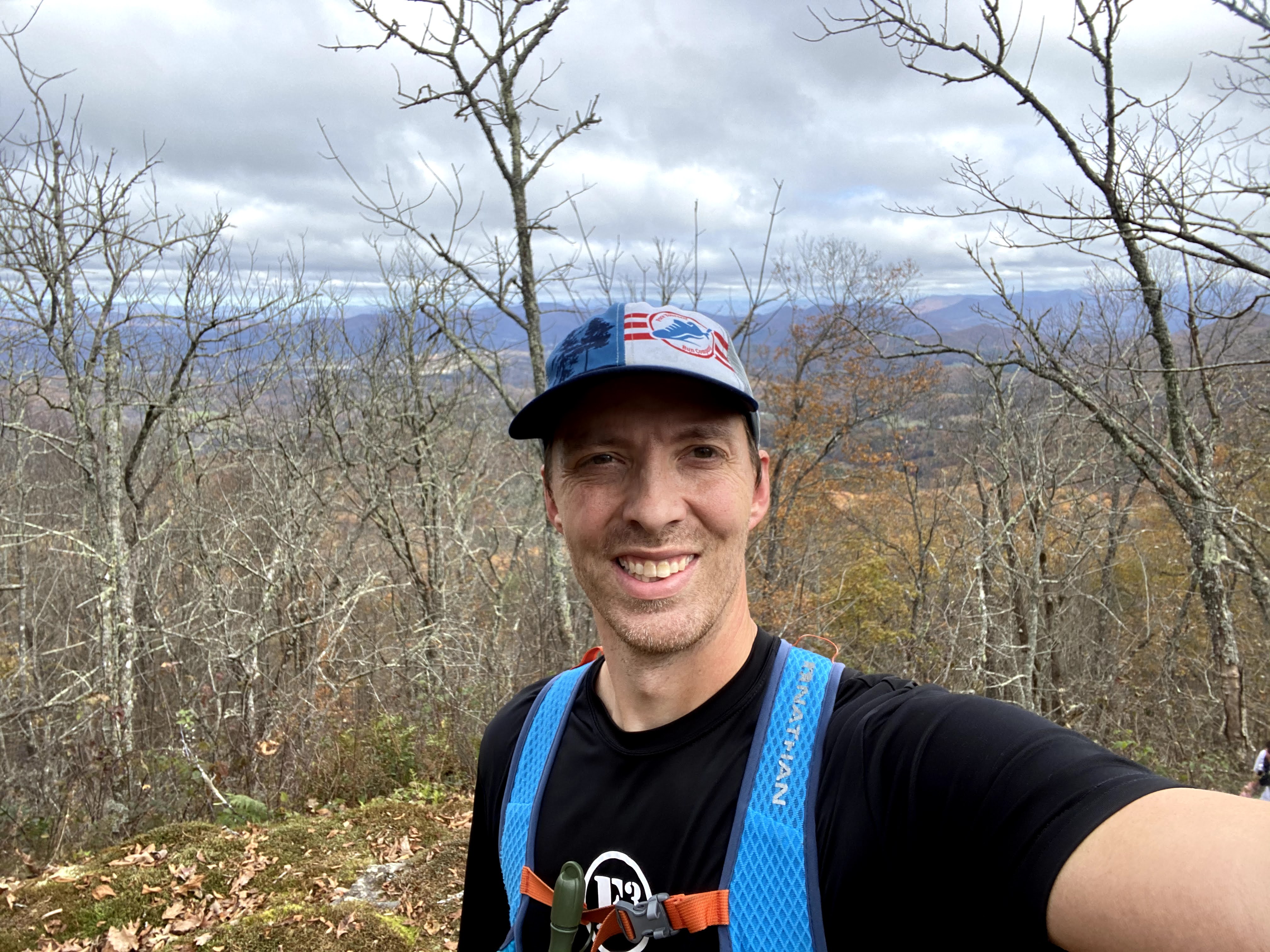
Still feeling good
    One thing that did give me hope was that the time allowed for this section and the required pace (8.5 miles in 2hr 20mins = ~16:30/mile) might mean that this section would not be too difficult. This turned out to be true - there were a few climbs but for the most part is was either gently rolling hills or mostly downhill. I even managed a few "fast" miles in this section (14 minutes), but did have a few that were 20 minutes also. That was bad news. But even worse was that I ran out of water about 2 miles before the aid station. This would be a compounding problem, because as I couldn't drink, I got quite dehydrated and I got cottonmouth. I also had zero interest in eating a 15th mini Snickers or more potato chips. The dry mouth made it very hard to swallow anything anyways, so I pretty much had no nutrition going in at this point.
 
    I started doing some math and realized that my race was going to come down to how quickly I could get in and out of the next aid station (cutoffs are based on when you leave the AS). The website said the cutoff here was 8 hours. We were around 7hrs 50mins when I heard the volunteers cheering us in. I mentioned to two runners next to me that I thought we were now in last place, because nobody else was going to make this cutoff. It would have to be a quick stop, no time to get anything out of my drop bag, and maybe just time to fill up my water and hope that would be enough. But WAIT - the volunteers told me cutoff was at 3:40 (we started at 7:20), and it was only 3:20 - I had found an extra 20 minutes! They must not have updated the race time for the cutoff (which I had been looking at), but the time of day for the cutoff was indeed accurate. This gave me some new life. I knew now that if I could just make it up to the turnaround point, I might be able to start building a little advantage over the cutoff times.
 
    After a few minutes at the aid station filling up my water and trying unsuccessfully to eat some food (bacon and quesadillas just weren't working this time), I left for the turnaround point right at 8 hours race time. 4.5 miles, 1hr 40mins to do it. This would begin my unraveling. I drank enough water that I wasn't thirsty anymore, but still had no appetite, and now my stomach was starting to make me feel nauseous. There were also two soul-crushing climbs - 700 feet in 1.5 miles immediately after leaving the aid station, followed by two miles down, and finally a 550 foot climb in 1 mile. By themselves these don't sound difficult, but after nearly 27 miles and 8 hours of hard work, they were brutal. I was still moving relatively well on the two downhill miles (16 and 18 minutes), but the second climb made me really doubt my ability to finish - a race-worst 27:34 mile. It really got into my head what I was actually approaching - not the halfway point, a moral victory that I was going to be halfway done in under 10 hours, with 14 hours to do the second part. Like a load of bricks dropped on my shoulders, it hit my mind that this was a TURNAROUND! I would have to go back and cover all of that same brutal ground I had already done. I tried to take some time and recover a bit with some ginger ale and salted potatoes. That food worked well, probably because it wasn't something that was really dry. But I probably should have eaten 10 times as much as I did. Feeling rushed, I left the aid station at 5:10 - still 20 minutes ahead of the cut. I hadn't lost any time race wise, I was still in good shape physically, but that isn't always enough. The mental game was starting to take a toll.

    One thing that helped despite how slow I was going was the constant encouragement from other runners who had already turned around. Everyone always gives you a "great job" or "nice work" or "keep it up" or "looking good" as we pass each other. I had a steady stream of that from the time the leader passed me when I was at mile 25 - he was at 40 and looked like he hadn't even broken a sweat. I was looking forward to more friendly encounters after I made the turnaround. However, that was short lived, as there were only 3 people behind me. I gave each of them precise amounts of their remaining distance and time before cutoff, but I don't think any of them made it. It was then that I realized I really was now in last place. No hope of someone catching up to me and we encourage each other to keep going. No more "good job" or "keep it up" encouragement. The sun was starting to set on the other side of the mountains as well as on my race. My one hope was that we were going back down the soul-crushing hills we had just climbed, and if I could keep a 20 minute pace I might be able to get to the Point Bravo aid station when some other runners were still there and we could head out together. 
 
    And that's exactly what I did - 19, 22 (on the climb), 20 and 19 minute miles. Rolled into the AS at 6:50, 11hrs 32mins into the race, and still 20 minutes up on cutoff. I was somehow also still ahead of my goal of 3MPH - I even had a 28 minute cushion on that average pace. But the night is dark and full of terrors. After complaining to the volunteers that I still couldn't eat, they pointed out all of the awesome food I had in my drop bag - Snickers, honey bun, Swedish Fish, peanut butter pretzels. I grabbed a few things and stuffed them into my pockets, where they would end up staying until I was done, except for a few Swedish Fish I ate in my last mile. I tried eating some bacon as I left the aid station, and after chewing it for 3 or 4 minutes I realized there was zero chance I was going to swallow that, so I spit it out.

    The next climb was really tough. Because I hadn't eaten much food for probably four hours now, I had zero energy. A thousand foot climb is the last thing I wanted to tackle. I was going as fast as I could, hanging with another man and woman in silence, nobody saying a word, suffering together, continuing to move forward with purpose. A one point they even said I could pass them if I wanted to, which I laughed because then I would be alone. I was barely holding on to the pace they were setting. Two miles took us 55 minutes and I realized that I was pretty quickly losing any extra time I had on the cutoff. Just keep moving, what goes up must come down, I think? I honestly couldn't remember anything about the course that I had just done the opposite direction not two hours ago. To make things worse, I had to stop for 30 seconds to step off trail to use nature's bathroom, and I sadly watched a couple of headlamps disappear into the distance, and I truly felt all alone out there on the mountain.
 
     Finally I hit a downhill and did some jogging, and managed a 20 minute mile. At this point, that felt REALLY fast. But not fast enough to catch up to my friends. Truth be told, I was just happy to be moving and not falling on my face on the dark trail with rocks covered by leaves. I laughed at the fact that I have only done maybe one or two trail runs in the dark. What an idiot I was to think Georgia Death Race was a good place to learn how to do night trail running! The excitement of the downhill mile was short lived, as I was soon climbing again. Mile 40 was crossed in 13hrs 8mins. I thought about the Barkley Fall Classic, and how the finish cutoff time for that race is 13:20, and surely what I had just done was harder than any BFC I had attempted. It was a little victory that I didn't appreciate during a race that was spiraling down the drain - but I do appreciate looking back now as a reflection on my progress as an ultra runner. More good news that I couldn't process - we were nearing the top of the climb before we descended a little over a mile down to the aid station. I started seeing lights of runners coming back up. The camaraderie I had been craving for so long was back. I think I passed ten or so runners and that was great. But what wasn't great was my ability to move - we were going downhill and I could barely walk. At this point approaching 14 hours, there was just a lot going wrong. Lots of blisters/hot spots, legs were cramping from lack of food (and really lack of training), and the worst thing that can happen at any race - I gave up mentally.
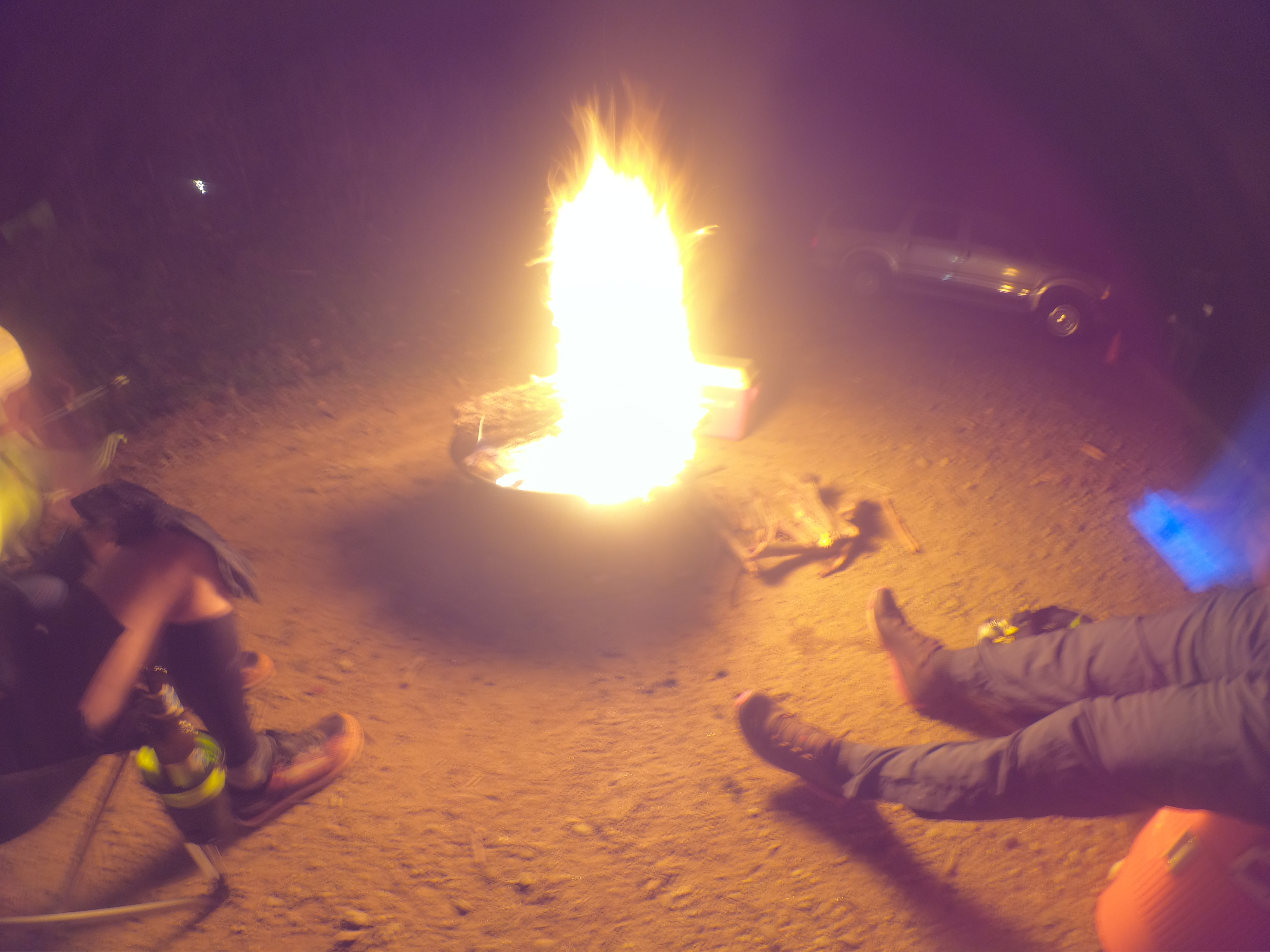
 
The allure of a fire and a beer,
a moth into the flame
    It took me over 28 minutes for mile 42 and I knew I was done. I had finally given up my advantage on the 3MPH average, and I was most likely going to miss the cutoff at Skeenah Gap. To make things worse, what I thought was a 1 mile descent just kept going and going. I couldn't even see the aid station, much less hear it. I texted Katie to tell her I was done, and she did what every great spouse would do - she called me and told me to get my butt in gear. What would Goggins say - "YOU DON'T KNOW ME SON!" I laughed and thanked her for trying to encourage me, but told her I was fairly sure I was done. All I could think about was how miserable it would be to climb back up this 1.3 miles that I averaged a 30 minute mile going down.  Finally it came into view, but I only had 5 minutes before cutoff. I got news from the last runner I saw that should have perked me up and got me excited - they were extending the cutoff by 30 minutes here! I told him that was the last thing I wanted to hear because I wanted to time out. Clearly I wasn't the only one - I rolled into that aid station and it was full of runners who were calling it a day. The aid workers had music blasting, lots of hot food, but what they also had was a fire pit and a beer. As I checked in with them, I told them I was most likely done. I sat in a chair away from the fire for 5 minutes to be sure, and after chatting with a few others about how tough it would be to climb back up, I moved the chair over to the fire and asked for that beer. I gladly accepted my DNF.

   
Final stats - 42.32 miles, 14hrs 6mins, 19:59 average per mile. I still had 23 miles remaining and nearly 10 hours to cover that distance. It turns out that the cutoffs were extended even more throughout the night because of how much more difficult the course was than the "normal" route, even up to 25hrs 30mins for the finish cutoff. I
only had to average 2 miles per hour to finish in that time. That stung a little when I found that out in the morning, as even my absolute worst mile was still under 30 minutes. My lack of course analysis is a big factor in me allowing myself to quit - had I known what the course had ahead of me I would have continued - from Skeenah I had to climb back up 1.3 miles, but then the course was fairly flat with small rolling hills for 4 miles. First time through there (mile 18-22) I averaged around 15 minutes a mile - surely I could have walked 25 minute miles? Then from there it would have only be 2.5 miles to the next aid station, and anyone can walk that far! I let that kick around in my brain for a few days after the race, and kicked myself for not having been mentally tougher, but decided I can't dwell on what might have been. I made the best decision I could based on the circumstances I was in. I'm proud of what I accomplished and I'm already looking forward to giving it another shot - maybe on the regular course next time.

    So what will I do differently? A lot of things, honestly. One thing that really made things difficult was the pack I was using. It's the same pack I have used for the past 4 years way back when I needed something to wear when training for a half marathon in North Carolina summer heat. It's a perfectly fine pack for shorter distances, but it didn't do the job this time. Once I had it filled up with all of the mandatory gear, the main compartment was so full that the hydration bladder could barely fit in there. That's most likely why I ran out of water and started the downward spiral - when I "filled up" at the aid station it probably wasn't even half full. Also the outer pockets are small, the front pockets are very small as well, and the side pockets are very difficult to reach without taking the pack off. In short, I couldn't comfortably carry and have easy access to enough food and water and gear. I've already remedied this situation with a new pack that should work much better on very long outings like this.

    The other thing I need to do is figure out how to actually train for these things! Although I had a lot of great runs in the six weeks or so leading up to this race, that wasn't nearly enough. I had some of my best 20 mile trail runs ever, and felt I did pretty well at Quest for the Crest, but the fact is I didn't have nearly enough weekly mileage and elevation gain to be fully prepared for this race. Most weeks I didn't even have 30 miles of running. I checked Strava for one guy I know that finished, and he was consistently running at least 50 miles a week. The change in life circumstances did make it difficult to keep a consistent schedule, but I also slacked off a lot when I could have made time i.e. getting up for early morning runs, or hitting the gym. That can all be resolved by setting my mind to being committed to getting better daily.

    There are some other small things, such as finding some more variety in food that I can eat, or being able to have more options for drinking instead of just water (the new pack can hold up to 4 bottles so I could have Tailwind, Gatorade, etc). Doing research on the course ahead of time and knowing what each section has in store, so when things get tough and seem overwhelming I can know how bad the course really is - or isn't. Running on trails at night to get more comfortable with running in the dark. I also need to stop being so prideful and thinking I can do these things all by myself, and ask for help in the form of a crew. Katie has done this several times for me, and does text/call me during races when she isn't there, and she is always awesome and a huge help. I can't try something like this without her, or someone else in her place if she can't make it.

    Final thought - Mistakes were made. I gave it my all. It wasn't enough. Next time I'll be better. Can't wait.

Saturday, October 24, 2020

2020 Quest for the Crest 50k (35 miles) Race Report

2020 Quest for the Crest 50k (35.5 miles)
October 17, 2020 at Mount Mitchell, Crest, and Buncombe
Trails in Burnsville, TN
Brutally hard course with the reward of incredible views that are worth the work
Watch time: 11:26:54
Position: 76/114 overall

     This race was supposed to happen in May, but was re-scheduled because COVID shut down everything, including all spring races. That was a good thing for me, since I was coming off a break from running and wasn't in great shape at that time. I got back in the groove of things over the summer and put in some solid training the past few months, despite now living on the road. I still wanted to do this race along with a few other runs in this area, so we have made our RV itinerary line up with my adventure runs / race schedule. Sure beats having to drive 6-10 hours on Friday, run on Saturday, then drive back on Sunday. 

    I didn't really know what to expect with this race. I've had some pretty good efforts lately, at the Vertical Mile Challenge back in August, and the Barkley Challenge Loop I did two weeks before this race. I've heard reports that this race is harder than my nemesis race, which I haven't finished in 3 tries. I think I'm in the best shape I've been in for a while, and with Georgia Death Race coming up in 3 weeks, I set 12 hours as a personal cut off - if I couldn't accomplish that, I probably don't have a shot at finishing GDR (but I will try anyways). 

    Another side effect of COVID was that the field was very limited and the course had to change. Normally it's a point to point run with 3 big climbs, the last being up to the summit of Mount Mitchell. The race director took many precautions, so we didn't go up to the summit b/c the crowds were quite large. Great call on his part. We also couldn't have shuttles drive us to the start point, so we ended up with a "barbell" shaped course, that was basically two huge climbs and two huge descents, with some ridge running in between. We also would only have two aid stations - we could also have drop bags at each one, and were required to bring a lot of extra gear, including a water filter, space blanket, rain jacket, and more. I never ended up using any of that stuff, but better to have and not need than need and not have.

View from Albert's Lodge
    We rolled into Albert's Lodge on Friday afternoon. They were gracious enough to agree to let us park our RV there. They even were able to give us an electric hookup, which came in real handy with overnight temps in the 30s. I can't imagine what the people who camped out in tents must have felt like, but I didn't really hear much complaining. I found out a few F3 guys were running, so I hitched a ride to the 5:15am start with them. They had been out on the original course a few weeks before, so I absorbed any bits of knowledge I could from them about the course. A good portion of our new route was still on the same trails as the original.

    We started off with the usual Run Bum cheer - "WE ARE HERE .... TO HAVE FUN!!!!" We had a quick mile run to spread out our small field of runners even more, before we hit the first climb. That was 4 miles with an average grade of around 15%. The trail was also littered with rocks and roots here and there, and nobody was really pushing too hard this early in the dark. My main goal was to get up on the ridge before sunrise. I'd say I timed it pretty well. I unintentionally captured some cool effects with my GoPro camera as the runners ran by with their headlamps on.

   
We had a flat few miles along the ridge, but this was just a giant mud bog. There are some places where it is so bad that they have cut tree stumps and placed them like steps. Good idea but when they get wet and muddy from other runners' shoes, they become pretty slippery and it's almost a better choice to run through the mud or on the edge of the trail. It was here that I realized I hadn't eaten or drank anything, so I thought I'd better get on that so I could prevent a big bonk later in the race. Well with temps on the mountain probably below 20 degrees, my water line had frozen! I stuck it inside my shirt between my pack and my back and it thawed pretty quickly so I could drink.

    As we approached the "small" climb up Big Tom, a runner had turned around and was heading back the other way. I asked if he was ok but he just had a disgusted look on his face. I wondered why at this point even if he was going to drop why didn't he just go on to the aid station. I soon found out because the next climb is brutal - 0.4 miles and over 500 feet gain - A 27% INCLINE! To make it even more fun, it is basically a boulder field. This was obviously the slowest section of the race, and it took me over 30 minutes for this mile.

    Now we would finally have some downhill! I was really looking forward to running some after nearly 3 hours of hiking. The only problem - the downhill was also full of rocks and roots and wasn't really run-able. I was really slow and cautious in this section, even if I was disappointed not to be cruising along down a well groomed trail to the first aid station. I had hoped to get to the first aid station around 4 hours, but I didn't expect to be taking over 20 minutes per mile going downhill. Despite the difficulty, the views of the mountains were stunning, and the terrain of the trail was always changing and was quite interesting.

    Eventually I got down to the first aid station, 13.5 miles, 4 hours and 45 minutes into the race. For most of the race to this point I had grouped up with 3 or 4 runners, and didn't really see anyone else. I was surprised that there were about a dozen runners at the aid station. The food fare at Run Bum races never disappoints, even with all the Covid precautions. Salted potatoes, hot soup, bacon, avocado wraps, PBJs, quesadillas, fruit, chips, cookies, Moon Pies, and more. All of this was a welcome site after a morning of just a few Snickers bars and a honey bun. After a quick chat to thank the volunteers, filled up my pack with more food from my drop bag, I was off for basically a repeat of what we had just done - a mile on the road, another huge climb, and another big descent. My thought was that this next section might take me slightly longer, being tired at this point, so I hoped to be at the second aid station by 10 hours. That would put a sub-12 hour finish out of reach.

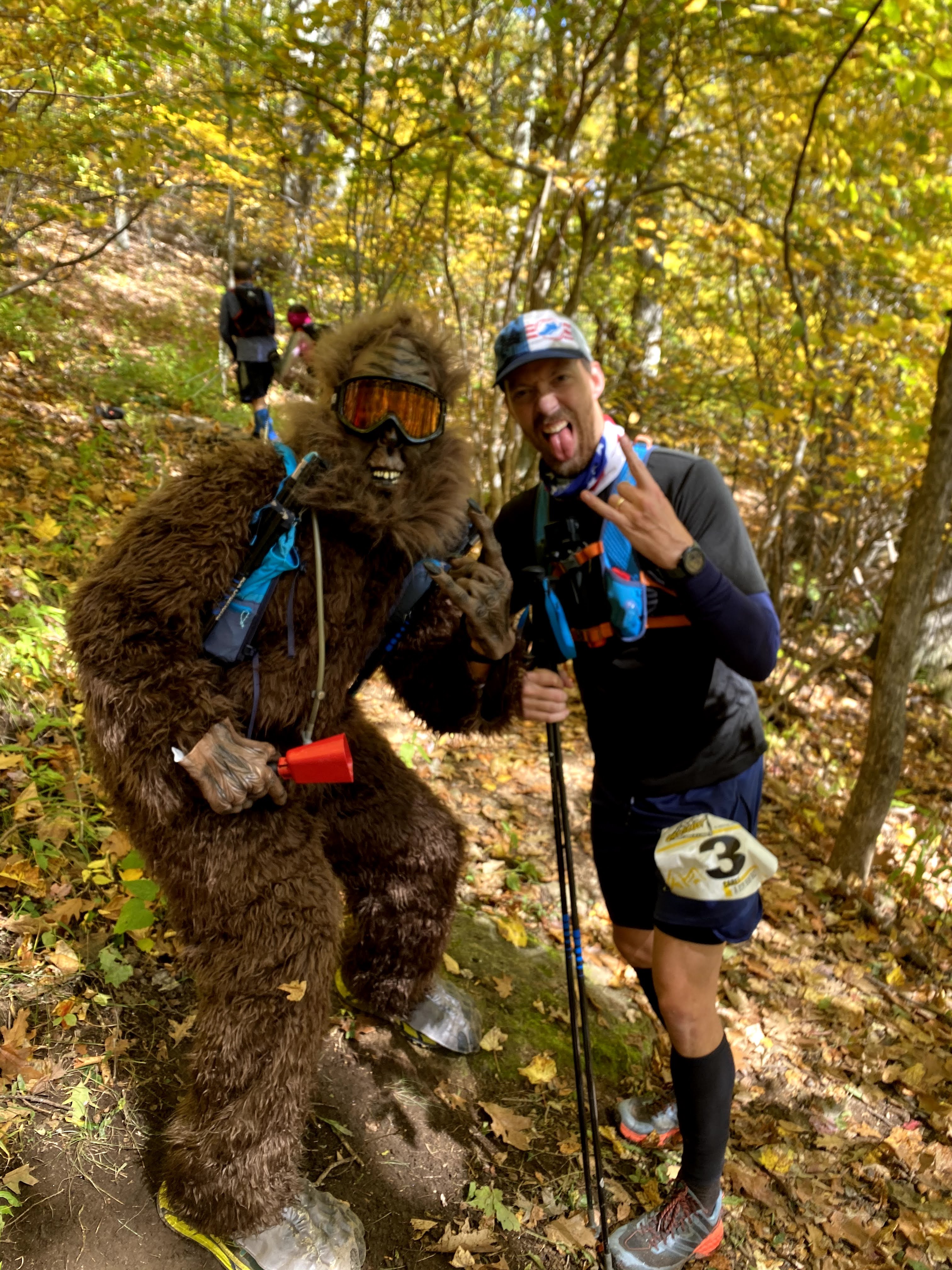
    It was actually about 2.5 miles from the aid station before the big climb really started. That ended up being a 5 mile uphill that was really steep for 3 miles (2,200 feet up / 14% average incline) and less steep for 2 miles (550 feet / 5% average incline). It was nice to find Bigfoot going up the second climb - just a volunteer there to cheer us on and give us a good laugh. Once we got to mile 20, the hard climbing was over and my legs were completely toast. We had a short little walk over to the best view of the day, where the race photographer was stationed. I took the few minutes to have a photo taken and enjoy the view before I got back to the trail. I had the course navigation running on my watch, which also gives you a projected finish time based on how many miles you have left and your average pace to that point. It told me that I was projected to finish around 6:45pm, which would put me at 13.5 hours! The cut off to finish was 14.5 hours so that was a little bit nerve wracking knowing I would be that close to cut-off. The good news was that we were basically done with the difficult climbing. The bad news was that if I had any problems along the way and couldn't recover or pick up my pace, I was in danger of not finishing. We had one last mile of climbing before we started on a long section on the ridge followed by some downhill to the second aid station.

    This section wasn't very technical.  There was about two and a half miles that was the same trail we ran earlier in the day, but before it was in the opposite direction and in the dark, so it didn't feel at all like something we had already done. Some sections were a bit muddy and there were a lot of small creek crossings, but there was also a long section that was grass covered and felt really good on my joints after all the rock hopping we had done earlier in the race. But my body and heart were just not into running. So I did what any respectable ultrarunner not having a great day but still wanting to finish does - I did a lot of power hiking, with maybe some 1 minute runs mixed in. I connected with a couple and we chatted a lot about races we have done together in the past. That helped pass a few miles but then they started running and I couldn't keep up with them. I made sure that I stayed on top of my eating and drinking, at one point downing probably 600 calories at once (this was probably right around lunch time so it made sense). I made sure to drink plenty of water since the day was heating up and I was too lazy to stop and take off my long sleeve, not to mention I had no room in my pack to stash it.

    I was steadily making progress on the estimated finish time. Even though I wasn't running, downhill power hiking was much faster than slow uphill hiking. I had been around a 22 minute per mile average, but now I was knocking out some 15 minute miles, with each of them taking 7 minutes off my estimated finish time. By the time I got to the aid station, I had lowered my average pace to 20:30/mile and my estimated finishing time was about 5:45pm. I walked into the aid station and they asked "what do you need.... ginger ale, gatorade, water, Fireball?" I made a beeline for the table to do a shot, followed by a bunch of bacon. I topped off my water, loaded the pack back up with the rest of the food from my drop bag, and headed out after about 5 minutes.

    We were now to the point of the race that Run Bum had told us to save our legs for. A little less than 9 miles to go of very runnable downhill. To this point of the race I hadn't really done much running at all, and after the gut bomb from the aid station, I got a huge surge in energy. I also knew that 12 hours was still within reach but I would have to push the pace to get there. I sent Katie a text and told her I thought I would finish at 5:30, but was going to push it for 5:15. I was trying to make sure I had a ride back to Albert's Lodge (where we parked the RV), but she didn't know where to go and my cell service was spotty so I only got a few messages through. I started with some slow shuffling, jogging for a minute or so, picking out a tree down the trail, and running to that. 

    Surprisingly, the more that I ran, the better my legs felt. I wasn't hammering out 7 minute miles or anything, but I was ticking off miles that continued to make my estimate time of finish 6-7 minutes earlier. Soon I had 5:15 and knew that I locked up a sub 12 hour race. I could have hiked it in at 20 minute miles, but I realized I could probably get a lot better finish time if I continued what I had been doing. We were on an easy downhill on a gravel road and I thought that was what we had left to the finish. With about 2.5 miles left, I was surprised that there was another aid station. It was on the pre-race info, but I never really paid attention to it since it was so close to the finish. I got a quick cup-full of Coke to get a nice sugar boost. Then we turned back on the trail and started climbing again! I remembered a few of the runners talking about this but had forgotten. Thankfully it was only a few hundred feet over a couple miles. With about a mile and a half left I could start hearing the finish line, but we had to do a big loop around to get down to it. I popped out of the woods and saw my kids sitting there waiting. Luckily Katie had found out how to get there, and got there early enough to see me finish at 4:45pm, much faster than I thought possible a few hours prior. I got the joy of running in to the finish line with all 4 kids.

    This is a very challenging race, probably one of the hardest I have done. Every race is different and I enjoy them all, but I think this one being so fresh in my mind and finally getting to run a trail race in the "proper" North Carolina mountains has made it my favorite. I had a great day as far as nutrition goes, never once feeling like I hit a wall. I only felt hungry a few times and was able to immediately eat enough to fix that. My pacing also seems to have been right on, since I was able to run hard for the last 9 miles and finish so strong. I will definitely do this race again, especially since the course this year is quite different from the regular course. Now to turn my focus to Georgia Death Race on November 7th... what could go wrong?!?

Tuesday, October 20, 2020

Barkley Challenge Loop run report

    This past Saturday I made a stop into Frozen Head to run the Challenge Loop. Let me preface by saying - in 2017 I ran BFC with no real trail running experience, and definitely not in BFC shape, yet managed a marathon "finish" because I had been running a lot of miles. 2018, same scenario, got in off the waitlist, not trained up, marathon finish after spending about 2.5 hours on Rat Jaw from 1:00 - 3:30. 2019, got in again, trained for lots of elevation and forgot how to run, after a great start ended with a DNF at the prison. I have made a few trips to the park for training runs as well, so I know the park trails well enough that I knew what to expect. Since I didn't get to run BFC this year, I planned a little detour as part of our travel from Michigan to North Carolina. We sold our house at the end of August and bought an RV to live in full time with our family of 6, for at least the next year (kids doing virtual school, and I work remotely). 

    After boondocking at the Oak Ridge Walmart Friday night, we hit to road to FHSP and I started my loop just after 10:00am. I am running Quest for the Crest 50k on October 17th, so this was going to be my last big training week for that. I wasn't exactly rested with fresh legs, but still felt pretty good overall. I made the first climb up Bird and down to the creek just over an hour, about equivalent to what I did at BFC 2019. The next part of the course up Jury Ridge and Bald Knob is what always kills me. I'm glad I don't know how many switchbacks are on that section, but it feels like about four thousand. I enjoyed the few short sections that are runnable, to give my legs a break from the power hiking. I managed to avoid the temptation at Bald Knob to cut over to the jeep road and call it a day, and continued on to Garden Spot. I got there (what I consider the half way point) just over 3 hours.

    With a steady supply of fun size Snickers and a Honey Bun, I got up to the jeep road to take back to Coffin Springs and on up to the Fire Tower. I was thinking 5hrs 30mins might be doable, but wasn't sure how my legs would hold up for the more runnable second half. Right around Coffin Springs I had my first problem - some cramping in my left hamstring. I knew this was because my leg strength wasn't there to be able to handle very well the 4,000+ feet of climbing to that point. I took a short break - a minute or less - to do some stretching and popped a few more Vitamin-S (Snickers) and continued on to the lookout tower. Once there, I spent a few minutes taking in the view from the top, and also admiring the path through Rat Jaw, happy that I didn't have to go that way today, and also that I will never be a leader responsible for breaking briars to clear the path up the hill.

    All I had left was an easy run down Chimney Top. I was right at 4 hours so I thought 5:30 might still be possible. My cramp kept coming back every time I had to climb, but legs still felt strong enough to run the downhill parts that aren't ridiculously steep themselves. And of course I forgot how many false summits there are on CTT. I have only been on Chimney once before - 2019 BFC - but it was in the opposite direction. I knew Rough Ridge was the last climb, but wasn't sure exactly where it was on the trail. I'm pretty sure I climbed it 4 or 5 times. After I got a little lost around one of the capstones, and my 18th mile took 27 minutes (according to my most likely inaccurate GPS). I knew 5:30 wasn't going to happen. I told myself it was ok to just hike it in and finish with whatever time I get. 

        Then I thought about BFC and my desire to get a finish, and how you have to run when you don't want to. So I kicked my sorry butt into gear and started running down the switchbacks, and wouldn't you know it, I saw a sign for Rough Ridge and still have one more climb to do! Suffered through that and started the last descent to the visitor center. As I was "running hard" (13 minute mile downhill) the only other runner I saw all day flew past me and out of site in a matter of 30 seconds. We did shout some words of encouragement to each other as he passed, and that kept me running to the end. I ran through the parking lot, touched the sign, and finished my run in 6:03:41. Not the time I expected, but all things considered I am still very proud about my performance for the day. I questioned if a similar effort on BFC race day would have ended in a 50k finish this year, but it's better not to waste my time wondering what could have been. I've signed up for the waitlist for BFC 2021 and will be training hard during the next year to make it happen.

Here is a link to my run - https://www.strava.com/activities/4147325434

Here is a link to my amateur GoPro video (only my 2nd time using it) - https://youtu.be/twImYDxScuI

Monday, September 23, 2019

2019 Barkley Fall Classic 50k

2019 Barkley Fall Classic 50k
September 21, 2019 at
Frozen Head State Park in Wartburg, TN
My first ever DNF - what happened?!?!
Watch time: 9:17:26 after I finally decided to cross the mat
Position: DNF! Made it ~24 miles (19.8 "Laz miles") with estimated 8,570 feet gain/8,380 feet loss - mapped using Gaia GPS software, definitely didn't wear GPS on race day

Exhausted at the finish line

TLDR version: I went all in attempting to get the 50k finish, but got my butt kicked all day and ended up dropping out after about 9 hours. Immediately swore off running anything ever again, then looked back 2 days later and realized I've made huge gains in two years and I'm already thinking about taking another shot at it.

REALLY Long version:
Back Story
A bit of background about my running history first. I never ran anything before I was 30 years old unless it was up and down a basketball court. While playing in a city league with a bunch of 30 somethings trying to hang on to their glory days of competitive ball, I destroyed my ACL/MCL because of a dirty play. After surgery my doctor said I definitely wouldn't be able to play basketball anymore. My injury was the worst he had ever seen after years of working on college football players. He even suggested I might need to wear a knee brace when mowing the lawn! Well I wasn't having any of that. Once I started PT I had a goal that by the end of 6 weeks I was going to be able to run 1 mile on the treadmill without stopping. I started the couch to 5k program from there, as I could run the few miles from work to home. A co-worker at the time had signed up to run his first half marathon, and being that it was 6 months away I decided to go for it. That progressed into training for my first marathon the following spring, and I held onto that fitness enough to finish the Run Woodstock 50k (my first trail race). That was 2013. And then..... nothing. Didn't do any consistent running for about 3 YEARS!

Fast forward to 2016 and my family moved from Michigan to North Carolina and didn't know anybody, so I decided to get involved with the local run club to meet some people. That jump started my running and I started signing up for races. Not long before someone asked me if I had heard about the Barkley Marathons. I went and watched the documentary and was fascinated. Soon I found out about the Fall Classic 50k, a chance to get a taste of Barkley. I really had no idea how difficult it would be, but I'm always up for a challenge so I put my name on the waitlist a few months before the 2017 race, for the hope of running in 2018. Mother Nature had other ideas and brought about a hurricane, which caused many runners to have to drop out of the race. It wasn't long before Laz was asking for anybody who wanted to run the race to let him know, and I had secured a spot at the start line, despite having done no trail running and definitely no training that would help me out at BFC. Needless to say, it was a sufferfest, but I enjoyed getting to climb some of the hills they talk about in the documentary, and putting myself to the test. Ultimately, I came up way short of finishing the 50k, but was ecstatic with a near 12 hour "marathon finish".

Registration for 2018 was opening and I wanted no part after being completely humbled in 2017, but figured I'd throw my name on the waitlist "just in case" I felt better about things later in the year. Throughout the winter I got a few more ultras under my belt - a 40 miler and a road double marathon with 7,500 feet of gain, so when the call came again for who wanted to run BFC last minute, there I was ready to answer. Surely with more experience, and knowledge of what suffering the park can dish out, I should have a better result. Little did I know that my brain would be baked that day on Rat Jaw from 2:00pm until 5:00pm, yes 1 mile that took me 3 hours. Despite that disaster, I got another marathon "finish" that was 8 minutes faster than 2018.

Weeks before race day
2019 was to be my year of redemption. I put in the lottery ready to do everything it took to secure the precious 50k finish. The lottery pulled name after name after name, but I knew all along that even if I wasn't selected that I would get in at some point, due to other runners dropping out. My name was called as one of the last few of the lottery, and it was go time! I did everything differently this year - way more time on trails, working on fast hiking and downhill running, lots of time on the treadmill at max incline (only 15% but way more than I've done before), even some workouts at the track to keep improving speed for the runnable sections of the park. I did the vertical mile race in North Carolina back in June (16 miles with 5,280 feet elevation gain and loss), before taking a four week vacation out west to South Dakota and Yellowstone where I spent a lot of time hiking up mountains and running down them. Even convinced my wife to stop at Frozen Head on the way home for a quick 2 mile run up Bird Mountain, which I did 15 minutes faster than in the 2018 race - training was paying off! Continued ramping up the training through the summer, which ultimately culminated in a 20 mile training run around Frozen Head in August, at the end of which I felt great. Nobody knew what torture Laz had waiting for us in September, but confidence was at an all time high...

Reviewing our map, wondering how
we can possibly do this?
That is until we saw the race map on Friday! From everything I knew about past races, this would be the hardest course yet. I would truly be tested to make the 50k cutoff, and even if I made that, it would be a challenge to complete the last section before being timed out. But I put together a plan for each part of the race - what time I wanted to be to the top and bottom of each climb. I would track my actual time to these spots for comparison later, something I also did in 2018. Having that reference of how long each section took last year was helpful, however it showed me just how hard I would have to be pushing all day to make it happen. Sections where I spent an hour last year would have to be done in less than 45 minutes. There would be several thousand more feet of climbing and, despite Laz's measurements, I'm pretty sure more mileage before reaching the decision point. Oh and the power line sections would all be done during the hottest part of the day, right before the decision point. I went to bed on Friday night ready to throw everything I had at the race, and hoped I could hold on long enough to get the result I so desired.

Race Day
Traditional race start - lighting of the cigarette
I lined up near the front, knowing that I would want to run fast to that first climb, and not get stuck behind a slow moving conga line. I ran past the yellow gate at a decent pace, and got into the first climb with a group that was moving almost exactly how I wanted - mostly fast hiking, mixed in with 30-60 second runs on the easier parts. Made it up the first climb just over 45 minutes - exactly what I planned! Was a bit winded at the top, but it was time to run, so no time to relax! We fly down the switchbacks, and I'm pushing hard, but as anyone who has been in this race knows, it wasn't long before I was completely alone! I knew there were others maybe a switchback or two above or below me, and I knew we would group back up on the next climb. Got down to the bottom and it was time to start hiking again. Now an hour into the race, I used this section to catch up on hydration, and downed probably a liter of the on-course electrolyte drink in the next long climb. To put in perspective how hard I was pushing, on the training run in August we did this section in reverse (all downhill) and spent 96 minutes (granted we were taking it easy at the end of a long day), but today going uphill (2.8 miles with 2,100 feet of climb) I did it in 74 minutes - 22 minutes better in the much more difficult direction. This effort did take it's toll - throughout that climb I battled cramps that started in my hamstrings, then moved to my calves, then caused pain in my hips and knees. But it would come and go, and I wasn't going to let that stop me - there will always be some pain at BFC. I would stretch them out, or take S-caps and drink more electrolytes, and after a bit they would go away. Even resorted to using a few sticks I found as make-shift rollers, with varying effectiveness. But once I got to the aid station, I felt a surge of confidence because of how good my time was to that point. Got my bib punched and thanked the awesome volunteers, and zoomed out of there for a 3.5 mile downhill run.

While chatting with other runners on Friday, we all agreed that to be at aid station #2 by 10:15 would be in great shape. I rolled in there for another punch, refilled my hydration pack, and took off up the next climb at 10:03. I couldn't believe how well my day was going and knew if I could cover the next 10 "Laz miles" in 4 hours, the 50k was within my grasp. The problem with that was I had never been on the next section of trail and had no clue what was ahead. The Chimney Top Trail, as far as I know, has always been the last loop of the race, reserved for those who made the decision point in time. It was a trail I was waiting to earn the right to climb, but because of the course being changed every year, Laz decided to put it early in this race. I am a huge numbers geek and I think that knowing how many switchbacks there are in the early climbs was a huge help - it gave me small easy goals to focus on and I absolutely count every one of them - makes the mental battle easier. Unfamiliarity can be extremely difficult, and I experienced much of that on the next trail. It starts with a really steep climb (one that I think can rival Testicle Spectacle or Methlab), followed by a short downhill, and then another steep climb of almost the same caliber. It is here that the cramps returned along with some lightheadedness of which I have never experienced. I would be hiking along at a good pace and a crew of 7 or 8 runners would be behind me. I must have been doing ok because nobody was asking to pass, but then I would suddenly get nauseous, dizzy and out of breath and have to step off trail and let that group pass. I would usually turn to see who it was in case I recognized a familiar face. Several past BFC finishers I recognized, even a certain Barkley Marathons finisher and a 2 time Fun Run finisher - that definitely made me question what in the world I was doing in front of them at that point in the race!! I would try to latch on to the tail of each group and that worked until it didn't. Then I'd be solo until another group caught up, I'd have to step off again to let them pass, repeat and repeat and repeat. The only thing more mentally defeating than getting passed by so many was what felt like the 73 endless false summits (maybe actually 5 or 6)! I couldn't understand what was happening to me, especially since I thought I had been executing well on nutrition and hydration (the major fail of 2018). I had done quite a few workouts in the 4-6 hour range and never had problems like this before.

Anyways, I trudged on to the next aid station. In my head my plan had completely crashed, which is completely ridiculous in retrospect. I wanted to be to that checkpoint by 12:40pm and I got my bib punch from Laz around 12:50pm. Chimney Top had taken 20 minutes longer than I had planned, but because of the early cushion I built I was still only 10 minutes behind plan - and I had given myself 2 hours on Rat Jaw (but hoped it would be more like 1.5 hours). But that 10 minutes seemed like an eternity and the first thought of doubt crept into my head. It didn't help that I heard Laz announce that we were getting close to the point of it being a real struggle to make the 50k cutoff. A few runners in front of me used that as a reason to stop, but I stepped right up to Laz and asked him to punch my bib because I was still going to go for it. I had four hours to make the decision point and only had a downhill run and the power lines ahead of me. Once we started the run was when the severe cramps and muscle weakness really took hold. This was an easily runnable down yet at the time it seemed like it was non-stop uphill. I knew I had to really push here to make a bit of time back, but I had absolutely nothing left in the tank. I was reduced to walking most of this section, with a few 30 second jogs here and there - which quickly resulted in cramps in my calves or hamstrings. I felt my 50k finish being ripped away because I couldn't run, what I thought was my biggest strength. I ate a Snickers, drank more, took a few more S-caps, nothing really helped. Finally we hit the last short uphill section right before the power line sections, and it broke me. It only gains a few hundred feet, but in this short quarter mile I could barely move between the cramps, dizziness and fatigue. I knew there was no way I could climb up Testicle Spectacle and Rat Jaw with any kind of pace to make the cutoff, and the marathon was meaningless to me this year. I lost all the fight I had left.

I walked into the aid station and the volunteers were awesome - all smiles and encouragement, but I told them that I was quitting. One told me if I was dropping, I had to hike back to the road where the EMTs were and they could drive me back, or I could sit down and re-consider. I sat down, drank some powerade and water, and for the first time in an athletic event, I cried. I buried my face in my hands and let my emotions get the best of me. It was kind of embarrassing to sit there and do that, but this was such a monumental undertaking that I had built up for so long, it was a crushing defeat to realize that it wasn't going to happen - and I couldn't understand why. I watched as several runners came back up with smiles on their faces (???). My friend Jenny told me that it wasn't so bad this year - it was only halfway down Testicle Spectacle to get the bib punch, then back up. That was all I needed to hear to re-light a small bit of fire! I jumped out of the chair and started heading down. No way was I leaving Frozen Head without at least a few briar scratches and a filthy outfit from buttsliding. I worked my way down to the bottom in about 15 minutes, which was 5 minutes faster than planned - was I going to rally and still have a shot at this? That rally lasted about as long as it took me to try to push up the first climb. Soon it was back to all the problems I'd had before, and I was climbing 10 feet and sitting down for a few minutes. I checked my watch and did some quick math, and there was no chance I could finish the climb, go down Methlab, through the prison and up Rat Jaw in 2 hours. It took me 40 minutes to go up TS and Rat Jaw was more than twice as hard. When I got to the top of TS, I knew I could then easily make it to the prison. I took another break, and profusely thanked the volunteer for helping me rally and keeping me going at least that far. She was sure I would get there and decide to climb Rat Jaw, but not on this day. I headed down Methlab and had some fun trying out some new techniques on the really steep sections (for next time?), and helping a few other runners find their way when the trail split a couple times - it's easy, stay under the powerline. A little over 30 minutes and I was rolling into the prison.

Escaping the prison and this hell of a race
And this is where I knew I had to stop. I still had plenty of time to finish the marathon, but I considered the constant dizziness/headache/cramps all as signs that something could go really wrong on Rat Jaw. Did my fear of repeating what happened last year (3 hours on RJ) play a factor? Most likely. Was I mentally beat down my Laz and Frozen Head and let it get the best of me? Most likely. Could I have kept pushing and made it up Rat Jaw? Most likely, but I'll never know. I made the call that I felt was right for me in that moment. It was an extremely difficult decision that I did not take lightly. This would be my first ever DNF, in the race that I invested more than any other that I've done.

As I was walking up to the prison's aid station, I saw my friend Tommy's wife Polina and we chatted for a while. I found out Tommy had been there 90 minutes prior - that absolutely made my day because that meant he was going to finish. And another run club friend Rich who had only got into the race 6 days before was making great time and ended up doing the marathon. Another friend Rick had a massive blister and had to stop at the prison also, so we chatted for a while at the aid station. I decided that I was going to still go through the prison yard, climb the wall, and go through the tunnel to ultimately stop before climbing Rat Jaw. After covering the first "10" miles in just over 3 hours, I spent 6 hours and 17 minutes to go the next "10", and then my day was done. I headed back to the aid station and saw my buddy Mark, who was intent on getting his marathon finish. I told him I'd see him at the finish line, then got a ride back with Polina so we could watch the finishers.

Post Race
At the finish line I saw several friends finishing, then decided I had time to go get a shower before Mark, Tommy and Rich finished. I grabbed my bag, headed across the field and to my surprise I saw Mark walking up. I gave him a big hug thinking something had happened and maybe he dropped half way up Rat Jaw. Turns out he was not allowed to even start it despite making it past the prison cutoff by 15 minutes or so. Sounds like there was concern about runners going up Rat Jaw that late in the day and were trying to avoid the risk of having to extract runners. We were both disappointed that he didn't get that chance to at least try, but understood it was a tough call for race officials to make. Now I'm hearing that Laz is looking for those runners and I'm sure will take care of them in some way. After showering and eating a delicious steak sandwich provided by the race, we sat there until the 13hrs 20mins final cutoff time, screaming and cheering for every runner that came down that last stretch of road. It hurt a ton to be on the sideline and not be running through the finishers chute, but it just wasn't my day.


I immediately decided I wasn't going to run this race again, and felt empty and defeated. I felt that the work I had put in was more than sufficient to finish, despite the more difficult course, and I couldn't understand why my day went so poorly after starting off so perfectly. Considering all of my symptoms and thinking back on my nutrition for the day, I firmly believe that I was suffering from a case of hyponatraemia - excess sodium in my system, which leads to retaining fluid and being over-hydrated. I drank three fills of my hydration pack of Sword - probably 3 servings each fill at 470mg per serving. Definitely not blaming the product, as I've previously had success with it - just not in this large amount. The food I ate also contributed another 300mg. All this while I only drank maybe 8 ounces of plain water all day. From a Runner's World article about sodium supplements while running: "Symptoms of hyponatraemia include nausea and vomiting, headache, confusion, and muscle weakness or cramps" - pretty much everything that I was suffering from after the first few hours of the race (minus the vomiting). Call it an excuse to quit if you want to, but trust me when I say that nobody wanted to finish this race this year more than I did. In the moment it felt like the right decision. The risk just was not worth the reward for me at that point. It also helped me realize that it wasn't my training or the effort I put in on race day that was my downfall. Despite all of the problems I had during the race, if I had continued to push and gone up Rat Jaw without issues, I probably would have just missed the decision point and finished the marathon distance with over an hour improvement. Considering that most of the top runners this year were around an hour slower than they were in 2018, I'd say I definitely could have finished on a good day. Of course, all that does is light the fire under me, and makes me want to give the Fall Classic yet another shot some day, armed with even more knowledge, experience and another year of growth. I'll definitely be back to continue chasing after that goal.

Lessons Learned
  • Obvious lesson - it takes many many things to go right to finish an ultra of this magnitude. Even one thing wrong can derail your race. Every runner I talked with afterwards said that you almost have to have the perfect day to finish this race (unless you are an elite or a long time veteran). You need a combination of sufficient training, good weather, fueling, pacing, and several other factors. My downfall was in my fueling strategy - which was overcompensating for my lack of fueling last year. Hopefully after this I can find the right balance for my next race.
  • DRINK WATER! It seems obvious, but plain water sometimes is all your body needs. It's important to pay attention to how much nutrients you are putting into your body over a certain period of time. Drinking Sword has been great to me all summer and I still think it's a great product, but it should be taken in smaller doses along with lots of plain water. Too much of a good thing can become a bad thing.
  • The 'F' is for did not FINISH, not FAILURE. Immediately after I was done, I felt like a failure. The fact that I built my entire training plan and race strategy made it sting even more. If I had been following a plan from someone else, then I wouldn't have to shoulder all the blame. It still all sits with me, but I've come to grips with what happened. I realize that my growth since starting this trail and ultra running journey has been far from a failure, and much more a success. I'm very proud of the growth I have achieved as a trail runner. The 2017 me would never have made it as far, as fast as the 2019 me did.
  • A day spent hiking on the trails (or running on the roads) is always a blessing. Some days you don't have your best performance, but this is what I do because it's something that brings me joy. Whether I finish first or last or not at all, I have to remember how lucky I am to even be able to do these things. To have the love, support and encouragement from family and friends - some even crazy enough to join me in these adventures - makes it even better.
  • I got a DNF, but also got a DNP, and that's WAAAAY cooler! Maybe I Did Not Finish, but at least I Did Not Poop my pants!

Tuesday, October 2, 2018

Numbers

I have an obsession with numbers. When I went to college, I was initially planning on being an accountant.  That quickly changed, however my love of math and numbers has never gone away.  My wife refers to me as the Human Calculator (not sure that really sounds like a cool super hero name) and will often times just ask me a math problem rather than wasting time typing it into her phone's calculator.

Of course that has translated over to my running.  Runners have so much data available to them it can be overwhelming.  Just during the course of a single run, I worry about things like - How many miles have I ran today?  What is my average pace?  What is my current pace?  How long is this interval?  What is my current heart rate? HOW MANY MORE MAILBOXES UNTIL THE TOP OF THIS HILL?!?!?  That's just during a run.  When I get home, I then analyze the crap out of my run on Strava.  I look at mile splits, my speed on different segments compared to last time (or the overall leaders), my fastest pace (sometimes when I sprint the end of the run), my total elevation gain, the list goes on and on.  And lastly, there are cumulative numbers that I'm always thinking about. How many more miles can I fit in this week? Will I get more than last week?  Am I on track for my monthly goal?  If I increase by 10% each week, how many miles will I end up with for the year?

My current fixation is on my yearly mileage - I have a goal of cracking 2,000 miles in a year for the first time in my life.  I currently sit at 1,735.4 for the year, needing 264.6 more miles for the year, over the course of 92 days, so I need to average..... wait, there I did it again! You can see my problem pretty clearly.  I have such a problem, that I recognize exactly what I am doing, and yet I am still not able to let it go, and I must tell you that I need 88.2 miles per month, or 2.88 miles a day to reach my goal.  If I stay on my current track of 6.36 miles per day, I will hit 2,000 in just 41 days (November 10th).  At that point I will probably decide to shoot for 2,200 or something in that range - 2222 sounds good!

I will say that the problem with the mileage numbers has actually worn me down quite a bit mentally.  My body is holding up well because I have been smart about doing a lot of runs at an easy, conversational pace.  I've taken a slow, cautious approach to building up my mileage, never increasing by more than 10-15% a week.   I have also done quite a bit of interval run-walking - it still all counts as mileage, just like if you do intervals at a race!  I think I won't be chasing a mileage goal next year so I don't have to have that cloud looming over my head all year. 

However, today I signed up to attempt the Barkley Fall Classic 50k again next year.  It is a lottery and it looks like I'll have maybe a 25% chance of getting selected.  But I know how the waitlist for this race works, and many people will drop out before the race.  So I am going to plan a full year around training for that race as if I'm in it.  I want to be ready even if I don't get notice until just a few days before the event.  My training plan will not focus as much on mileage this year, although there will be plenty.  I will be more focused on strength training, climbing, and just general "embrace the suck" activities.  My training goal numbers will be set around total elevation gain, which will just be a new obsession I have to pay attention to all year.

Why am I a slave to numbers like this?  There have been a few times that I have just left the house without my watch - or had the battery die in the middle of a run - and those have been some of my most enjoyable times.  Sometimes I wish I could "lose" my watch and not have all that data at my fingertips.  Although I would later just obsess over how many numbers I missed out on...

Tuesday, September 18, 2018

2018 Barkley Fall Classic 50k


2018 Barkley Fall Classic 50k
September 15, 2018 at Frozen Head State Park in Wartburg, TN
The Race of Redemption that wasn’t supposed to be – and so it wasn’t
Watch time: NO GPS!
Chip times: 11:40:12
Position: 105 out of 127 marathons finishers/203 50k finishers/83 DNF

Back Story
Let’s go back to 2015 when I started running with Holly Springs Run Club and met Amy Melle whose first questions were “Do you like mountain/trail running?” and “Have you heard of the Barkley Marathons?” That began my obsession, which ultimately led to me signing up on the wait list for 2017. Due to Hurricane Irma, several runners couldn’t make the trip last year, which led to me getting into a race I had no business doing. I had only ran more than 10 miles once all summer, but I accepted the challenge and happily finished the marathon just under 12 hours.
That jump-started my desire to be a serious long distance runner.  I’m not “fast” at the longer distance races, but I am incredibly stubborn and willing to put forth serious effort for a long time. I was already signed up for the Blue Ridge Double Marathon in April 2018, added a 40 mile race at Uwharrie in February, but intentionally put myself on the wait list so that I would attempt BFC again in 2019.  I sprinkled in a lot of other stupid, such as a solo training run marathon at 1:00am on Crossway (a 3.6 mile out and back I repeated 7 times, with something like 16 small hill climbs each lap), 20 loop repeats on the Heartbreak Hill/Soul Crusher loop (most runners around here don’t do that more than once or twice), nearly PR’ing a half marathon as part of a back-to-back long run.
After last year’s race, several of us joined a Facebook group for accountability and encouragement. It began as people training for BFC 2018 but became a group for anyone training for big races. It was helpful to see what others were doing for training.  I didn’t post in there too much aside from sharing that I was doing a lot of miles.  More on this group in a moment…

Weeks before race day
A few weeks ago, as in 2017, we realized that Hurricane Florence had decided to roll into North/South Carolina a few days before the race. Several runners had to cancel race plans to focus on their family and homes. That along with the fact that a lot of people drop out of this race for whatever reason, and race organizers were looking for people who wanted to run on short notice again.  Of course, some of those organizers are in the Facebook training group.  Hurricane Flo was predicted to take a direct path to us.  I had a quick conversation with my wife and she told me I better get my butt in gear, so we made plans that we would all go to Tennessee to get away and I would do the race.  On August 30th I was clicking the Accept button on the invite from Ultrasignup.  I even was able to use some of that connection to get another friend to run the race with me – even though he said he wasn’t trained at all he was willing to step up to the line.
I knew I was in much better condition than last year, plus had the ultra race experience of the past 12 months.  I had some regrets that I didn’t train harder, because I knew the chances of getting in were probably good, but I wasn’t sure if it would work out even if I had to opportunity.  So I went in with a plan that was similar to last year – do as much as I could with the fitness level I’m at, but don’t ever stop unless someone forces me to (because I missed a cut off), or until I finish.
Meeting Jared at packet pickup
There is so much outside of the race that makes this a can’t-miss weekend. We drove the 6+ hours on Thursday so we had plenty of time to relax and explore the area on Friday.  We went over to see the yellow gate, which signifies the start/end point of a lap at the Barkley Marathons. Met a handful of guys there for a little jog on the trail to loosen up after the long drive. Also met John Price, who has attempted the big Barkley 5 times, BFC every time, and Vol State 500k several times including once where he ran from the finish to start line before the race for a 1000k total. I love chatting with runners that have those experiences and great stories – I hope to be one of them someday.

We went to packet pickup and I got to meet Jared Campbell, the only 3 time finisher of the Barkley Marathons.  He is a very humble, cool dude who didn’t mind chatting with complete strangers.  He even went unrecognized by a few people who walked by while we were chatting, which I guess is typical for an ultrarunner as they still don’t gain much fame, despite him probably being one of the most accomplished ultrarunners out there. We then had lunch at the new restaurant built outside of Brushy Mountain State Penitentiary, which is where James Earl Ray (who murdered Martin Luther King Jr.) escaped from and spent 50 some hours Out There and only managed to get 8 miles away.  The race was created by Lazarus Lake almost as a way to mock that, as he figured he could run 100 miles in that time.  Food was great but decided to save the moonshine sampling until after the race.  We got to meet several other runners as we studied the course for Saturday.  Everyone had high hopes with there being a new section and going in a different direction than in 2017. We then went and set up camp in a local guy named Brian’s front yard along with a dozen other runners.
Supporting the Coalfield boys

Afterwards, we went to the race dinner put on by the American Legion of Wartburg, where we also got to watch the heartbreaking documentary of Gary Robbins’ journey to finish the BM – and ultimately taking a wrong turn a few miles from finishing and sprinting to the line from the wrong direction in 60:00:06, 6 seconds too late. All I could think all weekend was ‘How can these guys possibly go do a loop under 9 hours, take a 10 minute break, then go right back out? Insane!’ We were also treated to a high school football game at Coalfield – players who come out and support us every year at aid stations.  I think they were a bit fired up to have us cheering them, as they got out to a 27-0 lead in the 1st quarter! Shortly after that it was back to camp and early bed to get ready for a really long day in the woods.
Legend

Race Day
Woke up around 4:15 after a surprisingly good night of sleep. Knee, hip, right Achilles, left ankle have all been hurting the past few weeks, but today I feel like a machine.  Maybe it was just a bit of typical taper phantom pains? Maybe this will be my day and all will go well.  I have devised a plan for the course, breaking it down into about 10 different sections with notes on distance, elevation gain/loss, and predicted times.  It seems ridiculous to project a 3 mile section to take an hour and a half, but that’s how it is here
Being fully immersed in Frozen Ed’s book “Tales From Out There” all summer was such a big help, especially knowing things like there are 14 switchbacks from the yellow gate up to the top of Bird Mountain (our first climb).  It may have been annoying to everyone around me, but each time we hit one, I called out “1!”, “2!”, etc.  One guy thought there were 17, so when we hit 14 and I told him that meant we were at the top he was pretty elated.  A few people were already stepping off to the side to catch their breath, probably from starting out too fast. We stuck to our strategy of being in the conga line for the first climb, then we would be ready to run once we hit the descent. I mentioned to Mark that even though I had only been here once before, my experience felt much different than the first time.  In 2017 I was content to be the guy in the back of a group of 20, but today I was comfortable setting the pace and leading our group.  We hit the peak of Bird Mountain within 20 seconds of my projected pace – pretty good estimate! Next was the downhill part, where the fun begins! The park trails are narrow but very runnable, with some rock piles here and there and every once in a while a downed tree laying over the trail.  Being 6 feet tall has its advantages because most of them I was just able to step up and over, while some had to stop and spend extra precious seconds and energy climbing over.
Getting Out There in the wilderness

Just before the first aid station, our group was starting to separate a bit.  We were near 2 hours 30 minutes into the race at this point – at 7.6 miles, and we thought we were making good time!  The steepness of each switchback is pretty incredible in that you could only be one or two minutes ahead of someone but it’s impossible to see them.  I wanted to re-group after the aid station, but it was downhill running, and it was time to run our own race. It was time to make new friends with whoever else was on the trail. What I love about the trail running community is how social it is. When I run road races, everyone is focused on their pace and their watch and you rarely find people willing to talk.  Everyone here was friendly and helpful.  I tried to share some of my knowledge from a few sections where people got lost or wasted time last year, but some people wanted to confirm everything with their map and rely on themselves, which is totally understandable at Barkley. So after I gave them my advice, I had to continue on.
By the time I got to aid station #2, I was only 17 minutes behind my plan to get to Laz’s cutoff in time.  However I knew I had a 10 minute buffer, and I also had allotted 45 minutes each for the upcoming power line sections.  With one of them being downhill I knew I could make up some time.  There is a creek that runs through there, so I took the time to cool off a bit.  I had a few wipe outs in mud puddles earlier, so I washed off my arms and face, and dunked my headband into the water to help keep cool. A few people were fully laying down in the creek, but I didn’t want to risk the blisters or chaffing at this point. After quickly filling my water and getting my bib punched, it was time for the biggest challenges of the day – the power line sections.
Sometimes in a race, the dumbest things are what make you blow up.  In my case, I was a ticking time bomb, and something decided to cut the wrong wire early and make the bomb detonate immediately.  For the first few hours of the race, I was able to eat and drink fine.  But as the day went on, and temps climbed to the upper 80s with high humidity, my stomach was starting to feel knotted and I couldn’t eat.  I was constantly drinking water and having the volunteers pour Sword (on course electrolyte drink) down my throat from the gallon jugs. But because of no food – and thus no salt – at one point going up Testicle Spectacle (a path underneath power lines that gains 800+ feet in less than a mile) I stepped too close to a broken tree stump and the side of my shorts got caught. This left my leg stuck in the air and when I tried to lift it to get unstuck from the trunk, I got a massive cramp in my left calf.  I screamed out in pain and fell to the ground, and everyone around me immediately came to help – offering food, water, salt caps, anything I needed.  I graciously accepted some salt caps and apologized to everyone because I was right in the middle of the trail. I scooted over and they passed, assuring me I’d be fine and would catch up to them.  Going back down the other side of the crest on Meth Lab hill, it was so steep I was employing a slide technique with one foot extended straight out and sitting with my other foot underneath my butt to use as a break.  This caused a cramp in my right calf this time, with more screaming, and more awesome runners helping out.
I'm hurting by no chance I'm boarding this bus
Despite these problems, I made up some time coming down Meth Lab and rolled into the prison just 4 minutes later than planned.  But I needed rest at the aid station.  They had several crates for people to sit on and relax while the awesome volunteers attended to our every need – bringing us food, water, ice, throwing out our trash.  One of the guys I met at our shake out run on Friday was laid out with a full bag of ice on his head – he had been puking all day and had heat stroke and was pulled from the race, made to board the Bus of Disgrace and ride back to the finish line. I decided to switch from having water to Sword in my hydration pack, along with a lot of ice to help bring down my body temp.  I also filled my headband with ice to keep me from getting light headed.  I later heard stories of several people who passed out or were puking all along the course – I think this ice break saved me from that.  Unlike last year when I wasted 10 minutes at several places unnecessarily, I was out of the aid station in 6 minutes – a very well spent 6 minutes.
We ran through the prison yard and climbed a ladder over the wall to again meet Jared Campbell for a bib punch. On top of the wall, my toes decided to cramp up, which made Jared laugh – not sure if it was out of pity or because I was making fun of myself. I told him I was looking forward to the best part of the race – Rat Jaw.  He laughed and said “well the tunnel part is fun.” After jogging through there and getting a chance to cool down, we popped out to the base of Rat Jaw. I forgot how impossible just the first section looks.  There was one guy who was there a while before me, but decided he didn’t want to suffer climbing Rat Jaw just to miss the 50k cutoff and get a marathon finish. That’s not what I came here for – I was going to tackle this beast no matter what the final outcome.
Rat Jaw is several unrelenting, impossible to imagine climbs, some section so steep there is a metal cable for you to hold onto so you don’t slide back down.  And of course the briars, which may not slow you down but cause pain and make you want to quit.  But I knew that I went up it in 1 hour 25 minutes in 2017, and if I could manage a little bit faster this year, I would have about an hour for a 5 mile downhill run to Laz.  My legs were ready to run and felt strong at the beginning, but it wasn’t long before the heat and sun exposure zapped all my energy.  My heart rate was also out of control and they only way I could get it to slow down was to lay in the shade on the side of the trail, in a pile of briars. Rest a few minutes, get up and walk 20-30 steps, repeat over and over.  It wasn’t long before I realized my dream of a 2018 50k was out the window, and I went into self-preservation mode.
Welcome to Hotel Barkley Rat Jaw
Rat Jaw is also really two sections, first is Big Rat, then Rat Jaw – which they say gains 2000 feet in 0.8 miles.  There is a Jeep road where emergency personnel are standing by for anyone who isn’t willing to face the beast and wants to quit. When I got there, I took off my pack and laid flat on my back for at least 20 minutes, contemplating life and if I was going to continue.  Then I remembered something that I posted on Facebook, while Laz was pushing to complete his cross country walk in time to be there for our race. “Looks like Lazarus Lake is doing everything he can to make it back, putting in 29 miles yesterday! Remember his efforts to get to his finish line in time to make it back for us and the Coalfield boys, when everything sucks and you are dying next Saturday.” He also said at the pre-race dinner that he didn’t know how his legs kept moving those last few days, but somehow they did and he made it to the end.  Even though I wasn’t going to make my cut off, I owed it to Laz to keep moving and accomplish something that very few people in the world can say – I have climbed Rat Jaw and didn’t quit.
View from the tower
After Rat Jaw, there wasn’t a whole lot left of the race.  We climbed up the lookout tower to get a punch, I took a few pictures up there of the incredible views, then headed down the Jeep road to one last aid station. Then it was a nice easy 4 mile downhill run, which I had initially envisioned as being a sprint to beat the cut off, but since I was way beyond that I was jogging it with the goal of setting a BFC PR. I made it to Laz at 11:30 race time and told him that one of these years I will get into the race with more than a few weeks’ notice.  He told me that I should now know to train like I’m already in because of how the waitlist moves. I thanked him again for a wonderful experience and set off to collect my 2nd dog tag, and beat my time from last year.

Post Race
I was at first pretty disappointed with the marathon.  I held on to my goal pace for about 6.5 hours, and thought for a long time that the 50k might happen.  But that was all my body was ready to handle.  So it’s not surprising that I started running into cramping and exhaustion problems.  Looking back, I’m very happy with what I accomplished, knowing that my training was lacking what was needed for a 50k finish.  I think the heat also played a big factor, but that sounds more like an excuse and I live in North Carolina where it is routinely over 95 degrees.  Immediately after the race, I said I was never coming back and I didn’t think it was possible for me to complete the 50k.  Then I heard what others training was like compared to mine, and I know it is possible.  I’m now more motivated than ever to put in the work.  I have already posted in my training group to get ideas of things to do differently next year.  And I’m planning on bringing more friends along to share this amazing experience.

Lessons Learned
  • Training for Barkley Fall Classic requires more than just running miles. Actually after chatting with some friends shortly after the race, many of them said running mileage is pretty low on the priority list.  Everyone has different “favorite” workouts, and I think I will incorporate a little bit of everything – weight lifting, RUNNING hill repeats, hiking very steep climbs (or max incline on treadmill), heat training with a full pack, stair stepper/parking garage running, Jacob’s Ladder, dragging a tire while running, etc.  Maybe you want in next year and we can do some of that suffering together? 
  • Having a nutrition plan is just as important as every other part of the race. This part got away from me during this race.  I was great at staying hydrated all day, drinking between 6 and 7 liters of water and Sword.  However due to the heat, humidity, and pushing a little bit too fast for my fitness level, my stomach got into knots pretty early and I wasn’t able to eat. This lead to some pretty severe calf cramping going up Testicle Spectacle and down Meth Lab hill.  I was trying to eat low carb and become fat adapted through this summer, but I think a race like this may require something different than what I tried.  Back to the drawing board to experiment with some new things there.  Any suggestions from you fat adapted runners who have tried this race? 
  • Trail runners are awesome. Everyone I met before, during, and after the race was incredibly friendly. We helped each other plan, stay on course, shared food/water/salt tabs, encouraged people that were struggled, cheered on those that were passing, and celebrated everyone's day at the finish line, whether it was an early DNF or a strong 50k finish. We shared stories of our struggles Out There and started planning how we will do it better next time.
  • You are stronger than you think you are, but you will never know unless you try to do just a little bit more. I wasn’t strong enough to get to the cut off this year. But that joy is only earned with months (years?) of dedicated training, which I failed at doing this time.  That won’t happen again.  The difference in fitness compared to where I was last year, I need to grow that much more from now until next year to have a shot.  I have to keep this lesson in mind from January – September while I’m training, with the Croix de Barque reward always in sight.  Then maybe next year I will get the reward for all the blood, sweat, and tears I put into training.